Founders & Head of Product
Self-Serve Product Analytics
Your product team is flying blind while engineers are buried in tickets. Dreambase gives product, design, and growth teams instant access to real analytics directly from Supabase: no SQL, no tickets, no waiting.
By the time I get the data, the decision window has already closed.
The Value
Give your product team the answers they need without slowing down engineering.
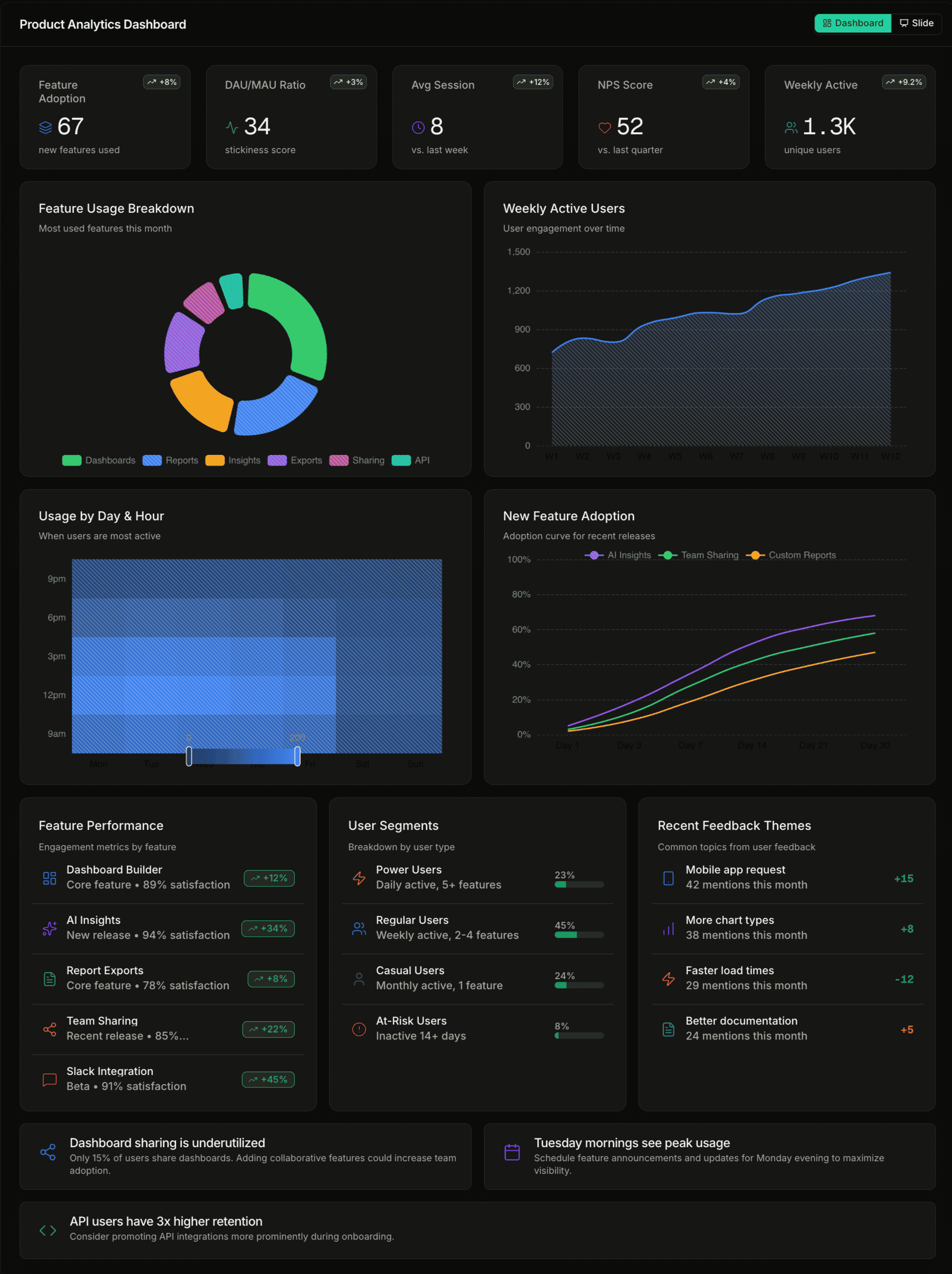
Product teams make better decisions when they have direct access to accurate data. Dreambase connects to your Supabase database and surfaces feature adoption, retention, DAU, and engagement metrics instantly — with consistent metric definitions your whole team can trust.
The Problem
Product and design teams need data to make decisions, but getting it requires engineering time nobody has to spare.
Engineers get pulled off the roadmap to run analytics queries
By the time data arrives, the context has changed
Every team member has a slightly different definition of "active user"
Reports are one-off exports that go stale immediately
Non-technical teammates can't explore data independently
The Dreambase Solution
Topics and Data Dictionary Define your KPIs and metric logic once. Every dashboard and report uses the same definitions automatically. No more debates about what "retention" means.
Self-Serve Dashboards Product, design, and growth teams explore and monitor metrics independently. Filter by cohort, date range, feature, or user segment without touching SQL or filing a ticket.
Quick Insights Ask a product question from the homepage and get an instant chart. No dashboard setup required for ad-hoc exploration.
Live Data, Always Dashboards connect directly to your Supabase database. No stale exports, no cached snapshots, no data that was accurate three days ago.
Before & After
Before | After |
|---|---|
File a ticket and wait 3-5 days | Answer available in seconds |
Engineer writes SQL, exports CSV | PM explores data independently |
Every team uses different metric definitions | Topics ensure consistent definitions everywhere |
Decisions made on gut feel or outdated data | Decisions made on live data from Supabase |
One-off reports that go stale immediately | Live dashboards always reflecting current data |
Engineers pulled off product work weekly | Engineers stay focused on the roadmap |
This is AI-native product analytics
For most product teams, analytics is a bottleneck disguised as a process. You need to know if the new onboarding flow is working. You want to understand which features power users are actually using. You're trying to figure out where people drop off in the activation funnel. These are reasonable questions. They should take seconds to answer.
Instead, they take days.
The typical workflow goes like this: a PM or designer identifies a question that needs data. They file a request, send a Slack message, or corner an engineer in standup. The engineer, already context-switching between three other things, adds it to the queue. A few days later, a CSV lands in someone's inbox. The PM formats it into a slide. By the time it's shared in the next team meeting, the product decision it was meant to inform has either already been made on gut feel, or the opportunity window has passed entirely.
This isn't an engineering problem. Engineers aren't slow. They're just optimizing for the wrong thing when they're the ones answering analytics questions. Their time is better spent building the product.
Dreambase solves this by connecting directly to your Supabase database and giving your entire team self-serve access to accurate analytics — without SQL, without tickets, and without pulling a single engineer off product work.
It starts with Topics. Instead of everyone having their own definition of "active user" or "engaged customer," you define your key metrics once in the Data Dictionary. Topics map your business concepts — feature adoption, user engagement, retention cohorts — to your actual Supabase tables and columns. From that point forward, every dashboard and every report your team generates uses those same definitions automatically. No more inconsistent numbers across Notion pages and slide decks.
From there, anyone on the product team can generate a dashboard or ask a quick question from the homepage AI assistant. Want to see how the new onboarding flow is performing over the last 30 days? Ask. Want a breakdown of feature usage by user cohort? Generate a dashboard. Need to understand retention by signup date? It's there in seconds, filtered and visualized exactly the way you need it.
The data comes from your Supabase database directly — not from tracking pixels, not from event streams, not from a third-party platform that's always slightly out of sync with reality. It's your actual product data, surfaced instantly by AI that understands your schema.
For engineering teams, the impact is just as significant. When product and design can self-serve their own analytics, the constant stream of "can you just quickly pull this?" messages stops. Engineers stay in deep work. Product teams stay informed. Everyone moves faster.
That's what self-serve product analytics should look like.
Self-Serve Product Analytics