Developer
Database Health Check
Teams building fast on Supabase with Cursor, Lovable, and v0 ship features quickly but often miss critical security gaps, missing indexes, and performance issues. Dreambase catches them before your users do.
We didn't know our RLS was misconfigured until a customer found it.
The Value
A free, automated Supabase health audit that finds problems before they become incidents.
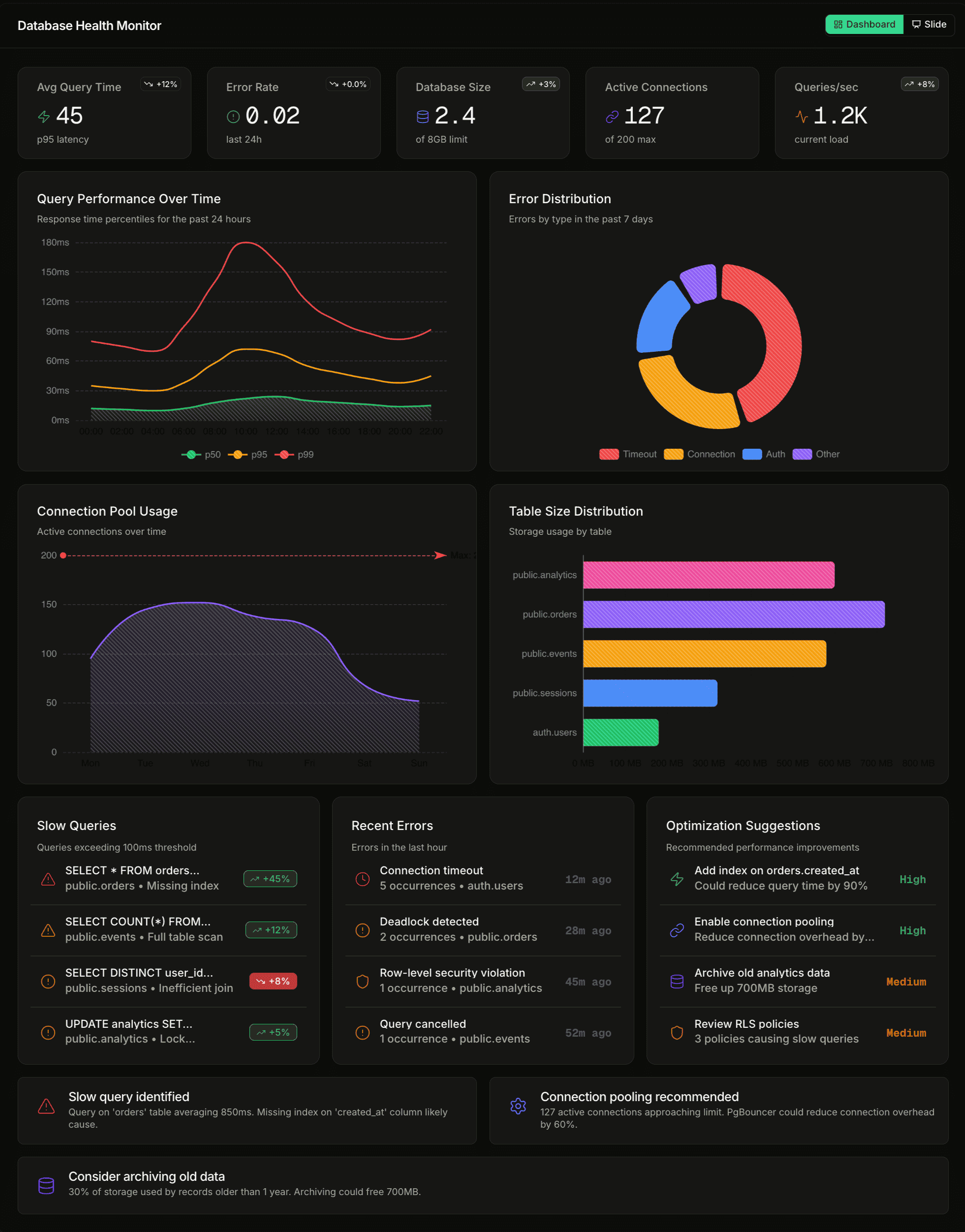
Dreambase scans your entire Supabase project and grades it across security, performance, reliability, and architecture. Every finding comes with a plain-English explanation and a one-click Fix in Cursor prompt so you can go from diagnosis to fix in minutes.
The Problem
Databases built fast accumulate health issues that are invisible until something breaks.
RLS policies are missing or misconfigured on tables that should be protected
Foreign key columns and frequently queried date fields have no indexes
Slow queries are degrading user experience but nobody knows which ones
AI coding tools like Cursor and Lovable generate valid schema but skip Postgres best practices
No systematic way to audit database health without a senior DBA on the team
The Dreambase Solution
Automated Security Assessment
Dreambase scans every table for RLS coverage, policy scope, and access control gaps. You see exactly which tables are exposed and how severe the risk is, with specific remediation steps for each finding.
Performance Analysis
Missing indexes on foreign keys, join columns, and date fields are identified automatically. Query performance patterns are analyzed and surfaced so you know exactly where slowdowns are coming from before users start complaining.
Agent Context for Fixes
Every recommendation includes a ready-to-use prompt for Cursor with Supabase MCP. One click copies the fix prompt. Paste it into Cursor and the fix is applied directly to your database. No manual SQL writing required.
Benchmarking Over Time
Run Report Cards on a schedule and track your health scores over time. See how each sprint of improvements moves the needle on security, performance, and reliability.
Before & After
Before | After |
|---|---|
RLS gaps discovered by a customer or a security audit | Every misconfigured policy flagged before it causes an incident |
Slow queries noticed when users complain | Performance issues identified and ranked before deployment |
No systematic way to check index coverage | Every missing index identified with a specific fix prompt |
AI-generated schema with no Postgres best practice review | Automated architecture review catches what Cursor and Lovable miss |
Fixing database issues requires writing SQL from scratch | Fix in Cursor turns every recommendation into a one-click prompt |
No visibility into database health trends over time | Benchmarking tracks health score improvements sprint by sprint |
Benchmark and improve your Supabase performance
The speed at which teams ship on Supabase today is genuinely remarkable. With Cursor, Lovable, v0, and Bolt, a solo founder or a small team can go from idea to deployed product in days. The schema gets created, the tables get populated, the app goes live. It works. Users sign up. Things move fast.
What does not move as fast is the accumulation of database health debt underneath it all.
AI coding tools are exceptional at generating functional schema and getting products shipped. They are not optimized for Postgres best practices. RLS policies get skipped on tables that absolutely should have them. Foreign key columns go unindexed because the query is fast enough with a hundred rows and nobody notices when it slows down at a hundred thousand. Architecture patterns that create problems at scale get locked in early because nobody flagged them when the database was small.
None of this is a failure of the tools or the developer. It is a natural consequence of moving fast without a senior DBA in the room. And for most Supabase teams, there is no senior DBA in the room.
Dreambase Report Cards are the automated equivalent of that DBA review, available for free to every Dreambase user.
Connect your Supabase project and Dreambase scans the entire database. Every table gets checked for RLS coverage and policy scope. Every foreign key and date column gets checked for index coverage. Query performance patterns get analyzed against your actual usage. Storage growth, error log rates, constraint coverage, and architectural patterns all get reviewed and scored across four categories: security, performance, reliability, and architecture.
The output is a scored report card with every finding ranked by severity. Critical issues appear at the top. Each one comes with a plain-English explanation of what the problem is, why it matters, and exactly what needs to change. No DBA jargon. No ambiguity about what to do next.
The Fix in Cursor feature is where the workflow really accelerates. Every recommendation includes a ready-to-use prompt for Cursor with Supabase MCP. One click copies it to your clipboard. Paste it into Cursor and the fix gets applied directly to your database. For most findings, the time from seeing the issue to having it resolved is measured in minutes, not hours.
For teams that run sprints, the benchmarking view tracks health scores over time. You can see exactly how a round of database improvements moved your security score, whether your performance grade improved after adding the recommended indexes, and where the next highest priority issues sit. It turns database health from a one-time audit into an ongoing practice.
The best time to run a Dreambase Report Card is before something breaks. The second best time is right now.
Database Health Check